turn down the raise, kevin.
 danny caballero
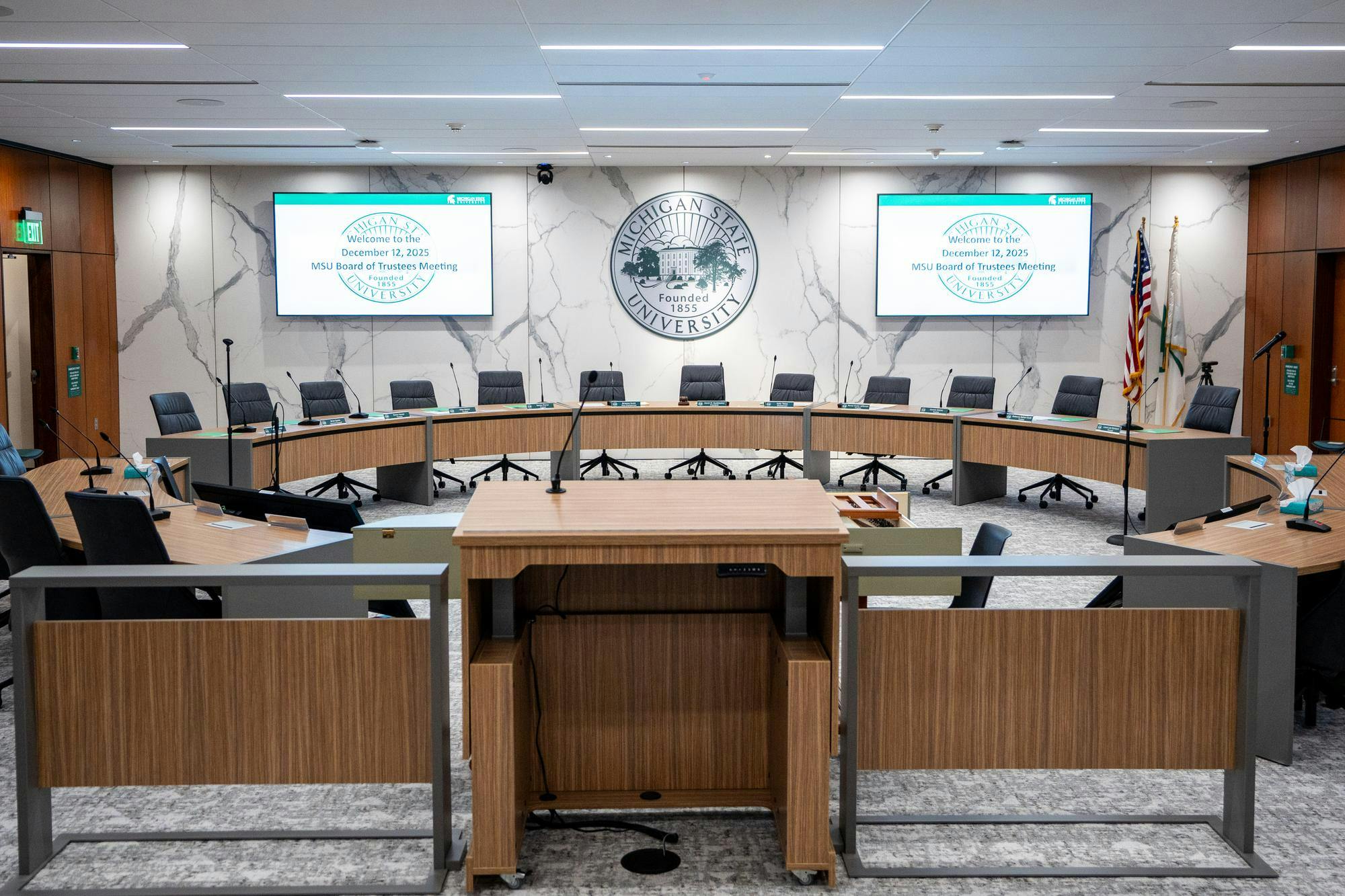
Photo by Ari Saperstein, The State News.
On Sunday, Michigan State’s Board of Trustees held a special meeting. It was announced the same morning. The Board did three things in a single Sunday night Zoom call. They voted 6-1 to double Kevin Guskiewicz’s salary, from just over a million dollars a year to two million, with a contract extension through 2031. They voted to overhaul the board’s code of ethics to prohibit individual trustees from publicly disagreeing with majority decisions. And they did all of it with less than twelve hours public notice, in a meeting the university acknowledged is not subject to Michigan’s Open Meetings Act.
In one evening, the Board bought the president’s silence and institutionalized everyone else’s.
I’m writing this for the faculty, staff, students, and Michigan taxpayers who fund this institution and deserve to know what is being done with their money. Not for the board. Not for any faction within it. For the people who show up every day and do the work.
Kevin Guskiewicz is not my enemy. He took this job under genuinely brutal conditions. He also put it in writing before he’d accept that he would only come if the board promised not to interfere with his leadership. By the board chair’s own public admission on Sunday, that promise was broken. Trustee Vassar said she spoke with him that same day and he told her he wants to stay. There was no active offer from another institution on the table. The board panicked preemptively and wrote a check.
I have sympathy for Kevin. By raising his salary, the Board put him in a unflattering position. It made him the face of a decision that was about much more than him. It made him the symbol of a governance structure that has been broken for a long time, and that has been producing decisions like this for a long time.
But this was never really about him.
who governs msu?
Here’s something worth understanding about who governs this place.
MSU trustees are elected in statewide partisan races and not through primaries, but through party conventions. The path to the ballot runs almost entirely through Democratic or Republican party infrastructure. Minor parties can technically get on, and sometimes do. They almost never win. Winning a statewide race with no convention machine behind you, in an election most Michigan voters don’t know exists, is close to impossible.
What that means in practice is that the people making decisions about faculty salaries, student programs, and presidential contracts are products of the same political machinery as your state and federal legislators. These people are shaped by party activists, donor networks, and ambitions that have nothing inherently to do with education. From my experience, some trustees genuinely care about this university and some are here for other reasons. By the time voters find out which is which, these people are already in the room making eight-year decisions.
That’s the system. It was designed this way. And it keeps producing this.
I also want to be clear. I’m not taking sides in the board’s internal fight. The dissenting trustees have raised legitimate concerns about transparency. The majority has made decisions it believes serve the university. All of them were put in this room by the same broken process. What I’m pointing to is the pattern underneath the personalities.
That pattern includes a $100 million private equity deal for MSU athletics structured without full board documentation, where trustees were told they could review materials if they signed a nondisclosure agreement. The board majority voted against subjecting any of it to the Freedom of Information Act. And Sunday’s ethics overhaul, which requires trustees to show “loyalty” in public and bars them from speaking individually about disagreements, was the majority’s answer to months of public dissent about exactly this kind of opacity.
This is a public university. Elected trustees are now being penalized for demanding transparency. That’s not a partisan problem. That’s a governance problem, and it happened in the same meeting where they doubled the president’s pay.
why do i find this so frustrating?
Inside that broken governance structure, a familiar pattern plays out.
I’m an endowed full professor. I have security most people at this university don’t have, and I know it. I’m not writing this because I’m worried about my own salary. I’m writing it because I got here through public money and public institutions, and that’s not abstract to me. It’s my entire biography. The students who walk into my classroom, the graduate students I train, the staff who make this place run — their stake in how this institution spends its money is real and immediate.
For the past five-plus years I organized with the Union of Tenure System Faculty. We did this work on nights, over weekends, and in hallways because the people who do the actual work here deserve to be heard. We built that union because decisions were being made without us, because workers, across MSU, had no recourse when conditions changed, because I was hired ten thousand dollars below a colleague and nobody told me I could push back. That organizing was unpaid. So is most of what keeps this university functioning: our teaching, our advising, our staying late when a student needs help, and, frankly, showing up every day because you actually believe in this experiment we call education.
And then the board doubled the president’s pay.
our budget tells a story
A budget is not a press release. It doesn’t tell you what an institution believes in. It tells you what an institution does when it has to choose, and hard choices have to made every day.
Right now we are cutting. Departmental budgets are down. Course sections are being consolidated. Student support has been reduced. Equity programs have been stripped not because any law required it, but as a straight policy choice. Federal courts ruled the Trump administration’s anti-DEI guidance unconstitutional. The legal justification MSU had been citing evaporated. The Department of Education also withdrew its support. And MSU kept cutting anyway. Programs that served students facing documented racial harassment on this campus went from $100,000 to $4,500. The VP for DEI position was eliminated. Staff were lost.
For all of that, the answer was: this is the environment. We all sacrifice.
Meanwhile the same board, in the same meeting where they doubled the president’s salary, has spent months structuring a $100 million private equity athletics deal behind closed doors and voting against FOIA transparency for it.
The money is always there for certain things. The will is always there for certain things.
The logic behind Sunday’s raise is that we cannot afford to lose certain things, so we find the money. Fine. But that logic has never once been applied to what we’ve already lost. The courses. The staff. The students who needed support and found the door closed. For those losses, the environment was the environment.
Sacrifices move in one direction here. They always seem to.
The governance structure that produced Sunday needs to change. Trustees of a public university shouldn’t be the output of a party convention machine that most voters don’t know exists. Any entity operating for the university’s benefit should be subject to the Freedom of Information Act. Trustees should not be able to rewrite their own ethics code to silence dissent in the same meeting where they make major personnel decisions.
These are not radical positions. They are the basic conditions of public accountability.
kevin, turn it down.
More immediately: Kevin, I’m asking you to turn down the raise, or to redirect a meaningful portion of it toward the programs and people who’ve been carrying this moment.
I recognize this may not be straightforward. A board decision is a board decision, and what you can refuse or redirect is a real question. But you took this job with conditions. You put your values in writing before you’d walk in the door. This is a chance to do that again and not through a contract, but through a choice that costs you something and says something true about what kind of institution you want to lead.
I want you to succeed. I want MSU to flourish.
You ask for our sacrifice. You ask for our belief in this place. You ask us to show up every day and do the work. This is a chance to show us true leadership and to demonstrate that you understand the stakes.
Turn it down.
The news about President Guskiewicz’s contract extension was reported by The State News on May 17, 2026. Context on MSU’s equity program decisions comes from trustee Rema Vassar’s guest commentary in Bridge Michigan. Discussions of the media venture and non-disclosure agreements stem from trustee Mike Balow’s and Dennis Denno’s op-ed in the Detroit News.
last 10 posts
> what are we even doing (8/8/26)> welcome back, kevin. now earn it. (7/14/26)
> kevin's leaving; what now? (6/10/26)
> turn down the raise, kevin. (5/18/26)
> labor is the hidden curriculum (4/27/26)
> show me your budget, and i'll show you your values (2/14/26)
> we can make different choices: the ice budget and what it reveals (1/31/26)
> jesus would be in minneapolis (1/25/26)
> we are losing a generation of scientists: speaking at aot (10/31/25)
> without nsf (5/2/25)
media i’m consuming
on the web
> an ai hate wave is here
> the day the mesozoic died
> claude
> inside the homeland security forum where ice agents talk shit about other agents | wired
> an ai agent published a hit piece on me – the shamblog
> rebuilding the employment security system for the rust belt that created it | brookings
> four frictions: or, how to resist ai in education - public books
> clamavnet
> github - jesseduffield/lazygit: simple terminal ui for git commands